
GAMIFICATION VS GAME-BASED LEARNING VS EDUTAINMENT VS SERIOUS GAMES
Game-based learning and gamification at immediate glance may seem like similar and interchangeable terms. While both terms combine games and learning, the difference lies in how game elements are integrated into the learning experience. This distinction leads to a larger difference in learning outcomes when comparing game-based learning vs. gamification.
The short answer: Gamification is turning the learning process as a whole into a game, while Games-Based Learning (GBL) is using a game as part of the learning process. ... Serious games and gamification are both trying to solve a problem, motivate, and promote learning using game-based thinking and techniques.

gamification origins
The fundamentals of Gamification have been used for decades, however, they had not been consolidated in concept to develop theory and practice. Since the 1980s, academics like Richard Bartle had already referred to Gamification as "turning something that is not a game into a game." In 1984 the book The Game of Work: How to Enjoy work as Much as Play was published, the American writer Charles Coonradt, which was one of the first management books that spoke of the benefits of the game applied to companies to increase productivity.
One of the first people to use the term as we know it today was Nick Pelling in 2003, a video game developer, who created a consultancy (Conundra) to create program interfaces with a gaming aesthetic and feel.
In 2005 ** BunchBall ** was launched by the Indian Rajat Paharia, the first company to use the concept of Gamification as close to how we know it today, since its objective was to increase the engagement and performance of companies through mechanics of game. The company in 2007 launched its Nitro product, a cloud software for integrating game mechanics to platforms, which served this purpose.
The term didn't really flourish until the early 2010s when consultants like Nicole Lazzaro, Jane McGonigal, and playful designers like Ian Bogost began to speak more fully about the benefits of games - broadly - to society.
In 2012, Whatron Pennsylvania University professor Kevin Werbach was one of the first scholars to specialize in Gamification and to delve into the subject as well as properly research it. He provided one of the best definitions of Gamification and the most widely accepted today, especially since it is neutral with respect to the particular interests of companies or organizations that want to profit from Gamification:
"Gamification is the use of game elements and game design techniques, in a non-game context."

PLATFORMS FOR EDUCATORS AND INSTRUCCTIONAL DESIGNERS
Educaplay
Create your own educational games
Kahoot
Kahoot! is a game-based learning platform.
Nearpod
Create K-12 interactive lessons, videos, and formative assessments. Built for distance learning, hybrid, and school-based settings.
EdPuzzle
Edpuzzle is an easy-to-use platform allowing you to insert questions into engaging videos for your students. Edpuzzle gathers data so that you can see what your students learned.
Quizlet
Instead of students answering individual questions on their individual devices, Quizlet puts students in groups. All possible answers are divided amongst the devices of all students participating.
Genially
Genially is a tool for creating interactive content that makes your audience fall in love. Communicate, educate, and attract by bringing your content to life.
Seesaw
Seesaw is a simple way for teachers and students to record and share what's happening in the classroom. Seesaw gives students a place to document their learning, be creative and learn how to use technology. Each student gets their own journal and will add things to it, like photos, videos, drawings, or notes.
Activities planning and development.
What type of learner are you? FIND OUT
Deckaholic

A collaborative site devoted to cataloging the universe of card decks and promoting this unique format as an ideal medium for exploring and human knowledge.
BoardGameGeek
BoardGameGeek is an online forum for board gaming hobbyists and a game database that holds reviews, images and videos for over 101,000 different tabletop games, including European-style board games, wargames, and card games.
game thinking
Game Thinking is the art and science of engaging customers on a compelling path to mastery. This approach combines game design, systems thinking, Agile/Lean UX and design thinking to help you build deeply engaging experiences and accelerate your path to product/market fit.
GAMIFICATION
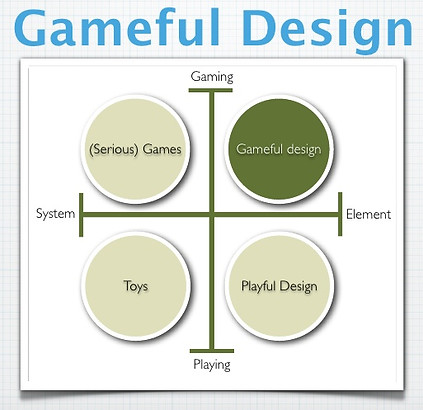
Gamification is the application of game-design elements and game principles in non-game contexts. It can also be defined as a set of activities and processes to solve problems by using or applying the characteristics of game elements. Gamification commonly employs game design elements to improve user engagement,organizational productivity, flow, learning,crowdsourcing,knowledge retention, employee recruitment and evaluation, ease of use, usefulness of systems, physical exercise, traffic violations, voter apathy, public attitudes about alternative energy
https://potion.social/en/blog/10-amazingly-successful-examples-of-gamification
Structural gamification is when a program has game elements included in the structure of the content but the two are unrelated. In other words, gameplay and communication content are not related, so this allows for greater program flexibility, higher efficiency, and cheaper costs. This includes your badges, higher tiers, progress meters, etc. Think of your LinkedIn profile and how users are motivated to achieve 100% profile completion simply by adding elements like a progress meter and tier levels. These are commonly used to drive engagement and motivation within your program.
Content gamification is when your program’s actual “fun” game elements are related to the game’s application. These are also known as “serious games,” and, because of the connection of your program’s goals to the game’s end result, these are more specialized, requiring higher intellectual capital (to play and create), and therefore are less flexible and tend to be more expensive. Common examples of these include Farmville, Duolingo, etc. They are commonly used as a training and/or learning method as a way to make it more engaging and more fun for the user.

EDUCATIONAL GAMES
Games for the purpose of educating people.
Primary goal: education
Secondary goal: fun
Examples: Math Blaster, Jumpstart, ABCya.com, Understanding Games
These are the kind of games that were made with teaching others in mind. People learn best when they’re actively engaged and using the material, so merging games with education is a natural combination.
Some of them—the best ones—have enjoyable gameplay to begin with. I think about some of the games in Jumpstart 3rd Grade, specifically the giving directions game or the one where you explore the planet with a spaceship. Those were awesome. They masked the teaching they were doing well.
Unfortunately, the games are often targeted at a very specific audience, which limits their appeal immediately. Sometimes it’s a real factor, like the fact that the fun is derived from solving addition problems. Other times it’s psychological (no less real): playing a game “meant” for 5th graders doesn’t really make a high school student eager to play, regardless of how good the game is.
The true weakness in this model of gaming is in making the education before the game. Contrary to popular belief, just because something is a “game” doesn’t mean it’s “fun”. When games are made to teach, they often forget the “fun” part in the process.
Great parody: Frog Fractions
EDUTAINMENT
SERIOUS GAMES
Serious Games are a gaming solution where a game is used in its entirety, however, the main objective of this is not to entertain or generate fun.
The main objective of a serious game is a totally different one from the fun end itself, and rather, the game becomes a means to achieve another end that mainly consists of generating knowledge, learning or solving a specific problem.
An example of a famous one is Fold It. A crowdsourcing initiative (open collaboration) so that people (players) from anywhere in the world, through a puzzle-type game, can fold protein chains to solve an infinity of possible combinations to find solutions to human diseases, such as AIDS, Cancer, Alzheimer's among many others.
People play Fold It because they have challenges to solve (puzzles) in front of them, and although they can generate some fun, the main objective and to which they contribute is to generate a benefit to humanity to cure diseases.

Simulation
A simulation is an experience in which participants can make decisions in an environment, where they can live the experience and consequence of their actions. In this decade, thanks to visualization technologies such as the Oculus Rift, simulation is increasingly being used for training processes where it is necessary to have a greater immersion.
It should be mentioned that Virtual Reality is a simulation, however, not all simulations have to be Virtual Reality.
A simulations are right in the middle of the spectrum of gaming solutions, focuses on the structure of what a game is, but without being a complete game. A simulation has a specific objective, for example, that people learn to drive without the consequences of making mistakes and accidents that they would have in real life.
The most important thing in a simulation is to achieve the environment of decision-making and consequences, but without having all the structural elements of a game.
That is why the simulation lacks less game elements than, for example, a serious game.
GAME-BASED LEARNING
Game-based learning (GBL) is a type of game play that has defined learning outcomes. Generally, game-based learning is designed to balance subject matter with gameplay and the ability of the player to retain, and apply said subject matter to the real world.
Children tend to spend hours playing hide and seek, learning the steps of digital games, such as chess, and engaging in creative games. Therefore, it can be said that play and learning are synonymous, leading to cognitive and emotional development inside a social and cultural context. For instance, the game of hide and seek. Good hiders need visual and spatial perspective to define the best hiding places, while seekers must be skilled at searching for cues from the surroundings and choosing the most probable location for the hider among various possible places.